
What Is HRV (Heart Rate Variability)? A Complete Guide to Your Readiness Signal
If you’re wondering what HRV actually means, and how to use it to improve your training, recovery and sleep, this guide breaks it down simply.
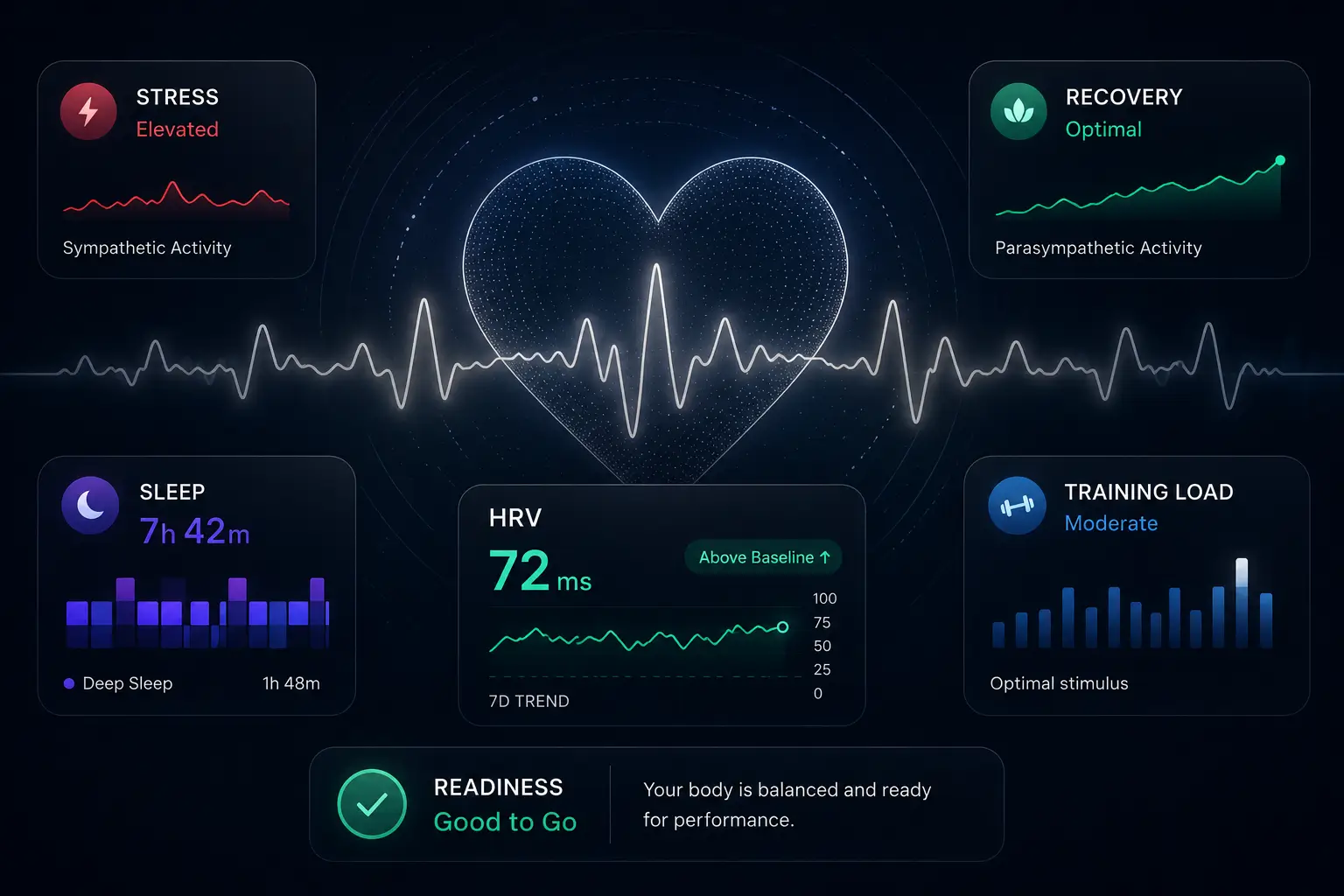
If you use one of the popular health tracking apps from Apple Watch, Oura Ring or Garmin, you’ve likely seen a metric called HRV (Heart Rate Variability). While your heart rate tells you how many times your heart beats per minute, your HRV tells you something more meaningful: how your nervous system responds to stress.
In 2026, HRV has become a popular barometer for measuring overall recovery capacity. But what exactly is it, and why does a higher number usually mean a "green light" for your training?
What Is HRV (Heart Rate Variability)?
Heart Rate Variability (HRV) is the variation in time between each heartbeat, measured in milliseconds. A higher HRV generally indicates better recovery and adaptability to stress, while a lower HRV can signal fatigue, stress or insufficient recovery.
The Simple Explanation
A healthy heart does not beat with perfect precision like a metronome. Instead, there are small variations in the time between each beat—where one might be 0.95 seconds apart and the next 1.05 seconds.
These small differences between beats are what we measure as HRV.
Why HRV Matters
Your HRV is controlled by your Autonomic Nervous System (ANS), which is split into two competing branches:
- The Sympathetic Branch (Fight or Flight): This branch activates when you’re stressed, exercising, or ill. It tells your heart to beat more regularly and quickly, which lowers your HRV.
- The Parasympathetic Branch (Rest and Digest): This branch helps you recover, digest, and sleep. It sends "relax" signals that create more variation between beats, which raises your HRV.
When these two systems are in balance, your body is adaptable. A high HRV signals that your nervous system is responsive and ready for stress (like a hard workout). A low HRV often means one branch (usually the sympathetic) is dominating because your body is busy fighting off fatigue, stress or early signs of illness.
What Is a "Good" HRV Score?
There is no universal "good" number. HRV is highly individualized and influenced by age, genetics, and fitness level.
- The Trend is King: A score of 40ms might be excellent for a 60-year-old but a sign of extreme fatigue for a 20-year-old athlete. For context, many adults fall somewhere between 20–100 ms depending on age, fitness, and measurement method. However, clinical research emphasizes that because HRV has no universal 'standard' range, your personal baseline and the stability of your score over time matter far more than any general population average.
- The Baseline: Modern apps (like Sonar) establish a baseline for your body. The goal isn't to have a specific number; it's to stay within or above your personal "normal" range.
What Affects HRV the Most?
If your HRV has tanked, one of these five "Biological Tax" factors is likely the culprit:
- Training Load: High-intensity sessions naturally drop your HRV temporarily.
- Sleep Debt: Even one night of poor REM/Deep sleep cycles can suppress your score.
- Alcohol: Alcohol can significantly suppress HRV for multiple days after consumption.
- Illness: Wearables often detect a drop in HRV 48 hours before you feel physical symptoms.
- Mental Stress: Your heart cannot tell the difference between a heavy squat and a stressful work deadline.
How to Use HRV to Train Smarter
Athletes increasingly use HRV-informed training to guide performance and recovery.
- High HRV (Green Light): Your body is primed. This may be a good day to push intensity or go for a PR.
- Baseline HRV (Yellow Light): You’re recovered. Proceed with your planned training volume.
- Low HRV (Red Light): Your nervous system is overtaxed. Swap your heavy lift for a Zone 2 walk, mobility work, or an extra hour of sleep.
Why Sonar Health is the Missing Piece
Apple Watch and other smart devices are great at collecting HRV data, but they often leave that data siloed.
At Sonar, we built the intelligence layer that connects the dots. We don’t just show you a number; we show you the correlation. We analyze how your nutrition, sleep stages, and workout intensity interact to move your HRV.
👉 If you want to actually understand what’s driving your HRV, not just track it, Sonar gives you the full picture across all your data.
Frequently Asked Questions (FAQ)
Is higher HRV always better?
Generally, higher HRV is associated with better recovery and adaptability. However, sudden spikes far above your normal range can sometimes reflect acute stress or measurement variability.
When should I measure HRV?
Most wearables measure HRV automatically during sleep for the most accurate data. This removes "noise" from posture, digestion, and daily stress.
Can I improve my HRV?
Yes. Consistent sleep, proper hydration, and cardiovascular fitness are the fastest ways to raise your baseline over time (often weeks to months).
About Sonar
Your body is talking. Are you listening? Sonar unifies all of your wearables, lifestyle, and biomarker data to unlock personalized insights and detection once reserved for elite athletes and biohackers. Trusted by 250,000+ users across 170+ countries, Sonar helps you cut through the noise across sleep, recovery, stress, activity, and nutrition - so you can focus on what actually matters. Sonar isn't just another health tracker. Launched out of Columbia University in New York, it merges the latest medical, sports and data science with AI engines that continuously surface subtle shifts and patterns across millions of data points, helping you know when to push, when to pause, and where to focus next.
More to Explore
September 17, 2025

September 16, 2025
June 13, 2025
Get the latest from Sonar
Share your email to stay up-to-date with all things Sonar
- English
- Bahasa Indonesia
- Bahasa Melayu
- Català
- Čeština
- Dansk
- Deutsch
- English (Australia)
- English (Canada)
- English (UK)
- Español (España)
- Español (Latinoamérica)
- Español (México)
- Français
- Français (Canada)
- Hrvatski
- Italiano
- Magyar
- Nederlands
- Norsk
- Polski
- Português (Brasil)
- Português (Portugal)
- Română
- Slovenčina
- Slovenščina
- Suomi
- Svenska
- Tiếng Việt
- Türkçe
- Ελληνικά
- Русский
- Українська
- עברית
- العربية
- हिन्दी
- ไทย
- 한국어
- 日本語
- 简体中文
- 繁體中文
EN